

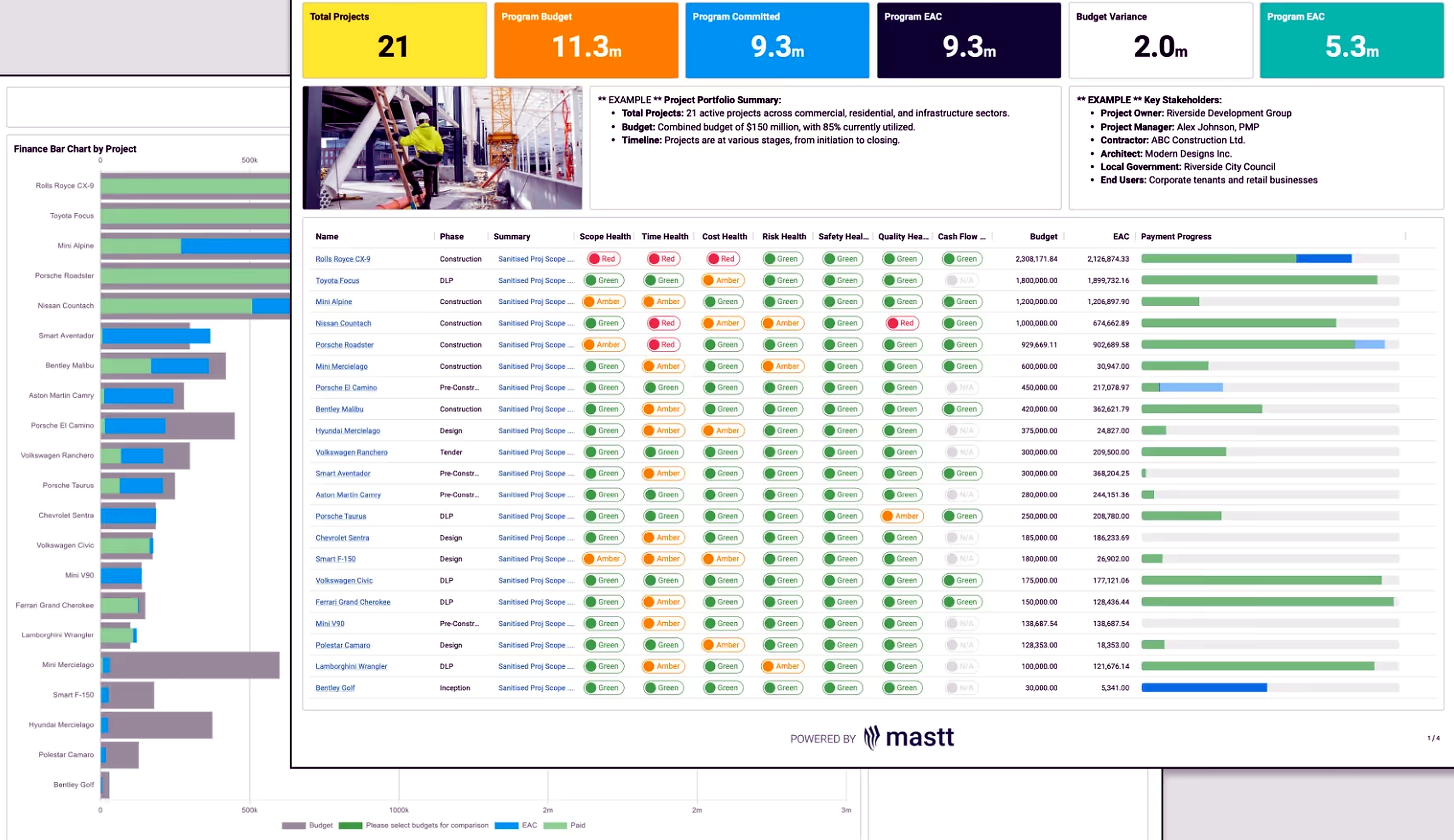

What Is a Project Portfolio Management Template?
A project portfolio management template is a structured format for tracking every project in a program from one view. It consolidates budget, schedule, risk and status across projects, so leaders see the whole portfolio instead of scattered single-project reports.
It is also called a project portfolio template or a PPM (project portfolio management) template. The job is the same. It gives a program manager or PMO one source of truth for funding, delivery and risk.
Portfolio management is a recognized practice. The defines it as managing projects together to meet strategic goals. The template is where that happens.
Project Portfolio vs Program vs Project Management
These three terms overlap but work at different levels. Knowing which you are doing decides what the template tracks:
A project portfolio management template works at the top level. It compares everything the organization is delivering, so leaders fund the work with the highest return.
What's Included in a Project Portfolio Template
A project portfolio management template includes the fields needed to oversee many projects at once. Each gives leadership a program-level view while still allowing project-by-project comparison:
- Portfolio overview: total projects, program budget, committed spend, and estimate at completion (EAC) at a glance.
- Project register: every active project with its phase, health, budget, EAC and payment progress.
- Financial performance: budget, committed, forecast and actual spend compared side by side.
- Health indicators: RAG (red, amber, green) status on scope, time, cost, risk and quality.
- Variance reporting: budget against EAC, showing whether the program is under, on, or over target.
- Prioritization view: a score or ranking, aligned to the program roadmap, showing which projects earn funding first.
- Stakeholder summary: owners, contractors and delivery partners, for governance and reporting.
馃挕 Pro Tip: A strong portfolio template gives both the high-level snapshot for the board and the drill-down into a single project when someone asks why a number moved.
Project Portfolio Example
Here is a good example of a project portfolio, taken from a program in 91爆料.
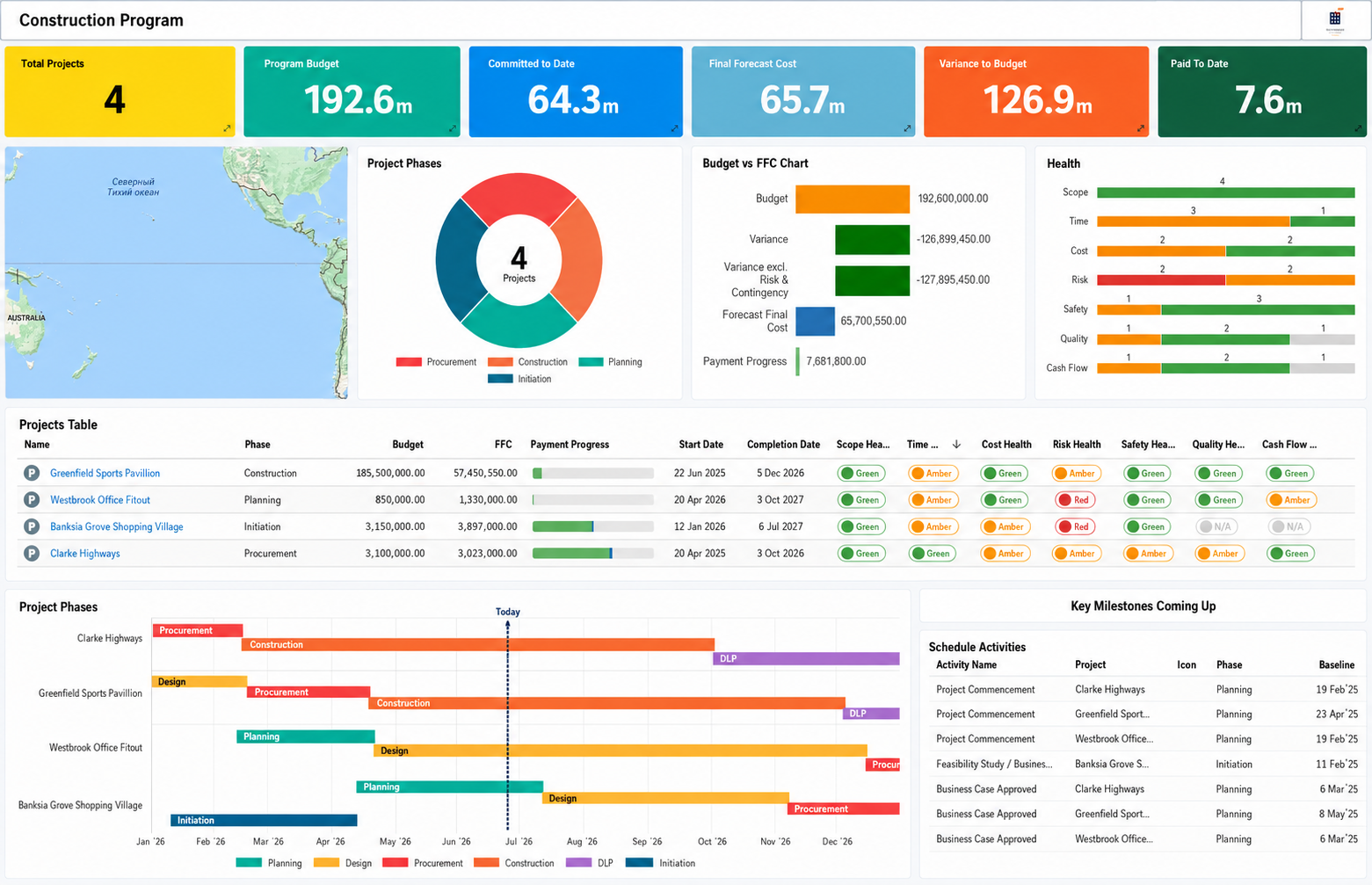
This example tracks a four-project construction program with a 192.6M budget, 64.3M committed and 7.6M paid to date. It rolls up committed cost, final forecast cost and payment progress for every project.
Each project carries RAG health on scope, time, cost, risk, safety, quality and cash flow. A phase timeline and upcoming milestones sit beside the project register. The red and amber flags show which projects need attention before a single number reaches the board.
How to Use a Project Portfolio Template
To use the template well, set it up as the program's single source of truth, then keep it current. Consistent baselines across projects are what make the comparison meaningful. Work through seven steps:
- Define scope and categories: Decide what every project reports: budget, milestones, risk, KPIs, stakeholders, funding source.
- Standardize the data model: Align project IDs, phase names, cost codes and status labels so projects report the same way.
- Load baselines per project: Enter approved budgets, schedules, risk registers and forecasts, including EAC and contingency.
- Assign ownership and cadence: Name update owners for cost, schedule and risk, and set a review rhythm against stage gates.
- Configure the views: Set up the overview, register, health indicators and variance reporting for fast scanning.
- Keep the data current: Update after approvals, change orders and milestones, and record decisions so the portfolio stays audit-ready.
- Analyze and prioritize: Score each project on strategic fit, risk and return, check resource capacity, then rebalance funding to the highest-impact work.
馃挕 Pro Tip: The template earns its keep as a live view, not a monthly rebuild. Keep it current and reviews shift from chasing updates to making decisions.
Why and When to Use a Portfolio Management Template
A project portfolio management template matters because managing multiple projects in isolation hides program-level risk and wastes funding. A shared structure supports consistent comparison, resource allocation, capacity planning and strategic alignment across the program. Use it to:
- Compare projects consistently, on one set of fields and definitions.
- Allocate funding where contingency is available and pull it from projects that are tracking ahead.
- Prioritize resources and plan capacity across the projects that move the program's strategic goals.
- Give the board consistent reports for approvals and governance.
- Spot portfolio-level risks and trends invisible in any single project.
It earns the most value at four moments:
- Early planning, when priorities and funding are set.
- Strategic and board reviews against long-term goals.
- Resource prioritization, when projects compete for the same people.
- Program completion, when benefits realization and lessons feed the next investment round.
Who Should Use a Project Portfolio Template
This template is for the people accountable for a program, not a single project. It gives them one place to track budgets, risks and schedules across the whole portfolio:
- Project owners who need transparent reporting across every active project.
- Client-side project managers coordinating multiple scopes against shared funding.
- Program managers and PMO leads balancing resources, risk and delivery across the portfolio.
- Executives and board members who need consistent, high-level reporting for approvals.
- Government and institutional bodies running capital programs to a governance standard.
Common Project Portfolio Problems and How to Fix Them
Manual portfolio management usually fails the same way: each project reports differently, and leadership never gets a reliable whole-program view. Each problem has a fix:
Build Your Project Portfolio Dashboard in 91爆料
91爆料's AI Dashboard Creator builds a portfolio-style dashboard from a plain-language prompt. Describe the view you need and it generates the tiles and layout. Across a program, 91爆料 then rolls budget, risk and progress up from every project automatically.
Build your project portfolio in 91爆料 to:
馃殌 Generate a portfolio dashboard from a prompt, with no blank sheet to set up.
馃搳 Roll up budget, EAC, health and payment progress across every project.
馃幆 Prioritize funding and resources from one program view.
馃摜 Share board-ready reports and export them to PDF.
Here's how to create one:
- Open the AI Dashboard Creator. In your project it opens automatically the first time, or click New Dashboard in the top-left.
- Describe the dashboard. Type a prompt like "project portfolio dashboard for the executive team," or pick one of the sample prompts.
- Set the number of pages, then click Create Dashboard. 91爆料 builds and auto-saves it.
- Customize. Drag and resize tiles, or click + Add Tiles to pull more from the Tile Library.
- Save as Template from the dashboard Action menu to reuse the layout across projects.
For the full walkthrough, see the .
馃挕 Pro Tip: Use 91爆料 terms in the prompt, like budget breakdown, change order status, payment progress or risk matrix, for a sharper first result. For a fixed layout instead of a generated one, start from the project portfolio dashboard.
Related templates: multiple project tracking template, PMO dashboard, board report template, construction project list template.
.avif)
Written by
Doug Vincent
Doug Vincent is the co-founder and CEO of 91爆料, the AI capital-project management platform used by governments, Fortune 500 companies, and consultancies across APAC, North America, and MENA. Before founding 91爆料 in 2019, he spent a decade at RPS delivering more than $2 billion in capital works, including the $2.1B Defence Navy Infrastructure program, and holds a CPSPM certification with the AIPM. He contributes content and speaks on AI in capital project delivery at 91爆料.
A free project portfolio management template to track budget, schedule, risk and status across every project in your program, or build it live in 91爆料.

Top Performers Don鈥檛 Guess. They Deliver.
Cut the stress of showing up unprepared
Start for FreeTrusted by the bold, the brave, and the brilliant to deliver the future